If you’ve ever hesitated before touching a toilet flush on a train or held your breath in a plane cubicle, you might’ve been onto something.
We’ve commissioned new research that has uncovered what’s really lurking in UK public transport toilets - and it’s enough to make you want to pack a hazmat suit along with your passport.
We carried out independent lab testing at various transport locations across the UK - airports, planes, trains and ferry terminals, using a swab test format.
A Germ Hotspot at 30,000 Feet
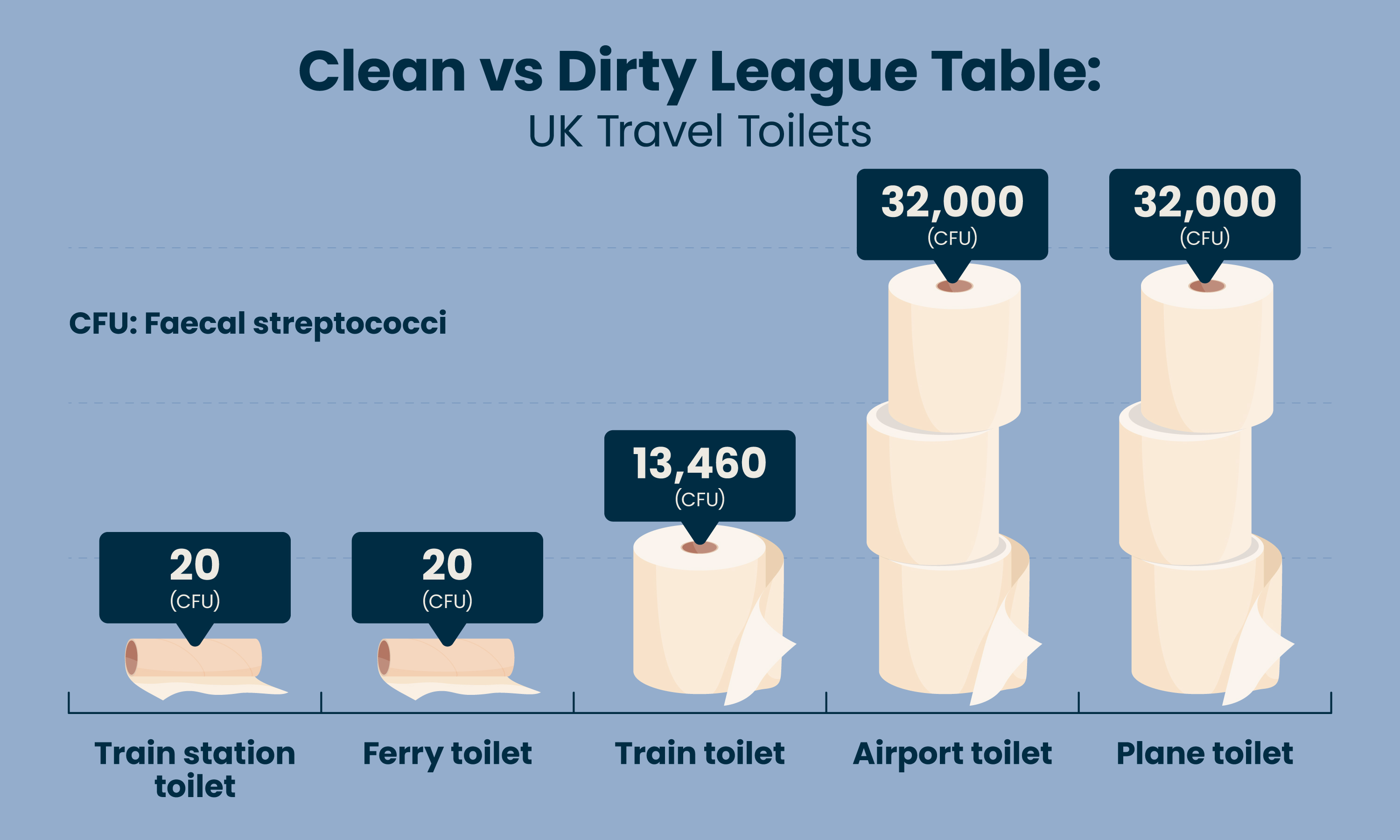
The results? Airport and plane toilets showed over 32,000 colony-forming units (CFU) of faecal streptococci.
Train toilets came in behind, sitting at over 13,000 CFU, but the good news is that ferry toilets fared better, returning significantly lower bacteria levels - proving that your safest bet for a travel toilet break might be on the water.
| Location | Escherichia coli (CFU) | Staphylococcus aureus (CFU) | Clostridium perfringens (CFU) | Bacillus cereus (CFU) | Pseudomonas aeruginosa (CFU) | Faecal streptococci (CFU) | Salmonella spp |
|---|---|---|---|---|---|---|---|
| Airport Toilet | <10 | <20 | <10 | <20 | <20 | >32000 | ND |
| Airplane Toilet | <10 | <20 | <10 | <20 | <20 | >32000 | ND |
| Train Toilet | <10 | <20 | <10 | <20 | <20 | >13460 | ND |
| Train Station Toilet | <10 | <20 | <10 | <20 | <20 | <20 | ND |
| Ferry Toilet | <10 | <20 | <10 | <20 | <20 | <20 | ND |
What Does This Mean for Your Health?
According to NHS guidance, bacteria like E. coli, Staphylococcus aureus (or Staph aureus), and faecal streptococci are not just unpleasant - they can pose a genuine health threat.
These microbes are commonly associated with illnesses such as food poisoning, diarrhoea, and skin infections. In more vulnerable individuals - including children, the elderly, pregnant women and those with compromised immune systems - exposure to these bacteria can lead to more serious complications, such as urinary tract infections, respiratory issues, or even hospitalisation.
What’s especially troubling is how easily these germs can spread: all it takes is touching a contaminated surface and then your mouth, face or personal items.
Your Travel Hygiene Habits
The most concerning part is that these bugs aren’t just sitting politely on toilet seats. They’re on door handles, flush buttons, cubicle locks - the surfaces you can’t help but touch on your trip to the bathroom.
The good news is: a little prep goes a long way when you’re travelling.
Here’s what we recommend:
- Antibacterial wipes – perfect for toilet handles, flushes, and taps
- Hand sanitiser – your pocket-sized solution for after you’re finished in the bathroom
- Tissues – for opening doors or pressing buttons
- Common sense – close the lid (if there is one) before you flush, and try not to let your bag or clothing such as jackets and coats touch the floor to avoid the risk of carrying any bacteria with you on your onward travel.
These small habits can make a big difference, and keep yourself and your family safe from hidden nasties on your holidays and staycations this summer.


