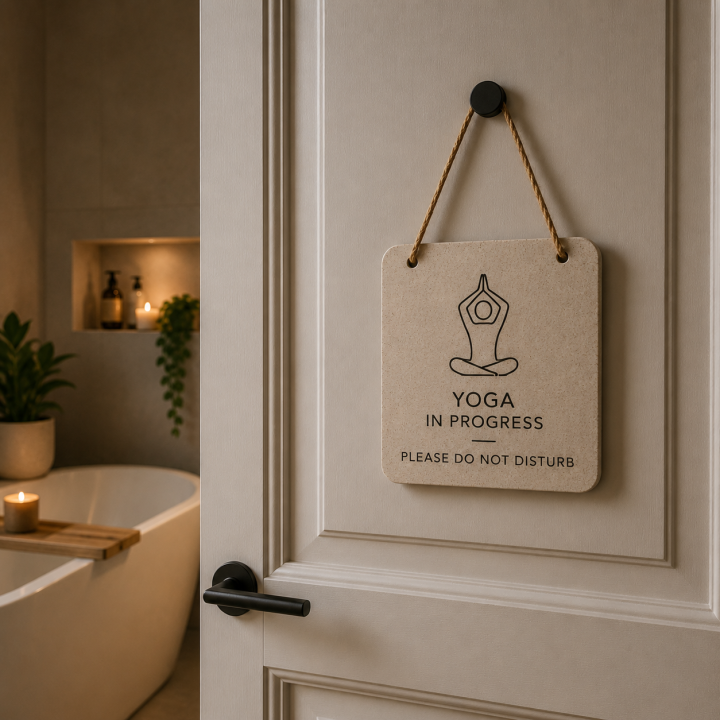
Ask what the bathroom is for and most people keep it short: wash, brush, get out. It's the practical room; the functional one; the place nobody lingers for too long, unlike other rooms in the house. However, new research suggests younger adults have other ideas for the bathroom.
Sanctuary Bathrooms asked 2,000 UK adults, spanning every generation from Gen Z to the Silent Generation, a series of questions on the activities they’ve done in the bathroom. The results show that among Gen Z and Millennials in particular, the bathroom is becoming a hybrid space of sorts - part self-care zone, part media room, part quiet retreat to practise hobbies away from the hubbub of the rest of the house.
You may have seen this behaviour described as ‘bathroom camping’, as though young adults overwhelmed by a busy world were simply hiding behind a locked bathroom door and doomscrolling. Our data points somewhere more positive: young adults giving their bathroom a second job, rather than simply retreating from their lives; using it for entertainment, personal routines, and solitary downtime that the rest of the house can't always offer. In smaller homes especially, where a spare room isn't on the cards, that doubling-up earns its keep - it's the same flexibility behind a lot of our small bathroom ideas.
In this report, we look at what Brits are really doing in the bathroom and why its role may be shifting for younger adults.
How is the Role of the Bathroom Changing?
For a long time, a bathroom’s value was measured by its functionality and practicality. Traditionally, the questions asked of it were: Does it work? Is it easy to clean? Is there enough space? While those considerations still matter, our survey suggests newer generations also care about what lifestyle benefits the space can bring, beyond the purely functional.
Here's how those headline priorities compare, setting Gen Z and Millennials against the national average for all UK adults.
Source: OnePoll for Sanctuary Bathrooms, January 2026. n = 2,000 UK adults. Subsamples: Gen Z n = 331, Millennials n = 564. Respondents could select up to three characteristics, so columns do not total 100%.
Compared with all UK adults, Gen Z were less likely to name functionality as a top priority for their bathroom (34% versus 46%), and far less likely to emphasise practicality (25% versus 41%). In their place came things that make a room more of an experience.
That reordering of priorities shows up clearly in behaviour, too. The table below shows the share of respondents who said they have personally done a particular activity in the bathroom.
Source: OnePoll for Sanctuary Bathrooms, January 2026. n = 2,000 UK adults. Subsamples: Gen Z n = 331, Millennials n = 564. Respondents could select all answers that applied, so columns do not total 100%.
The pattern is hard to miss. For almost every 'out of the ordinary' bathroom activity we asked about, younger generations were more likely to have tried it than the national average. Millennials came out top when it came to listening to music, doing skincare, and reading books in the bathroom, while Gen Z were more likely to say they had watched TV and films and managed fantasy sports teams. On mindfulness, language learning, and yoga, the two groups are effectively level.
"For years, the starting point for most people planning a bathroom was the plumbing, fixtures and fittings, and most crucially, the cost”, says James Roberts, Director at Sanctuary Bathrooms. "These days, younger buyers are starting with what they actually want to do in the bathroom – whether that’s to unwind, catch up on a show, or grab ten minutes to themselves - and working backwards from there. They're treating it as a room in its own right; a space for really living in, not an afterthought."
So, what do all these numbers add up to? We can split the stats into three categories, each pointing to a different job the bathroom has taken on: a self-care sanctuary, a media hub, and a place for hobbies.
The Bathroom as a Self-Care Sanctuary
The clearest theme in the data relates to self-care - a shift we explore more in depth in why the bathroom has become Britain's emotional HQ.
Skincare, Make-Up, and Beauty Routines
Among UK adults as a whole, skincare, make-up, and beauty routines are the most common bathroom activity of all, named by 57% - more than any other activity we asked about. Among younger groups, they're even more common, done by 61% of Gen Z and 66% of Millennials.
Lighting Candles or Incense
Alongside the routines comes the atmosphere. Half of Gen Z (50%) and more than half of Millennials (56%) have lit candles or incense in the bathroom, well ahead of the national figure of 41%. It's a minor ritual, but it tells you the room is being set up as somewhere to slow down rather than rush through. It's the same instinct behind candles for relaxation, an aromatherapy shower, or a few shower steamers - small touches that turn a wash into a wind-down.
Practising Yoga, Mindfulness, and Meditation
Then there's the more inward end of the spectrum. Around four in ten younger adults - 40% of Gen Z and 39% of Millennials - have practised mindfulness or meditation in the bathroom, compared with 29% of adults overall, while almost a quarter (24% of both Gen Z and Millennials) have done yoga. For a room that's still, private, and enclosed, that's not as surprising as it first sounds. When it's the one place you can shut the door, it becomes the obvious place to switch off and recharge.
None of the experts we asked found this surprising. Geetanjali Bhalla, wellbeing expert and founder of consultancy Vastu Shastra, believes that bathrooms are being intuitively reframed from a ‘release space’ into a ‘reset space’. She attributes this to the types of living situations younger people increasingly find themselves in: "Many younger people are living in smaller homes or shared spaces, which means they don't always have access to dedicated quiet areas. The bathroom, therefore, becomes a practical solution, a place where they can create a moment of pause without interruption."
"Especially if you live in a busy household, the bathroom can become a safe haven," agrees Lexi Frier, Reiki teacher, practitioner, and founder of Nature Angel. "There is usually access to water, which can be really grounding and cleansing, and in most cases, you can lock the door, giving you space and privacy."
For Eloise Skinner, psychotherapist and yoga instructor, the appeal runs deeper than convenience. "We naturally associate the bathroom with a self-care space, since many of the activities we do there can be self-care related," she says. "The private nature of the environment also helps, as well as the association we have with peace and quiet, relaxation and a time to be present with ourselves. In a world full of distractions, we might feel the bathroom is the only place we can go without being disturbed, or without needing to respond/check our notifications."
Then there's a physical logic to it, too. Liz McGurk, founder of personal-training business FitPod and former GB modern pentathlete, points to what the room does to the body: "Warm water, softer lighting and familiar daily rituals help signal safety to the nervous system, making it easier for the body to shift out of 'doing mode' and into relaxation. Even small moments, like taking a few slow breaths while running a bath or stretching after a shower, can become powerful daily reset points."
The takeaway for anyone planning a bathroom, young or old, is that mood and comfort now carry real weight. Warm, layered bathroom lighting, a quiet extractor, a little greenery from the right bathroom plants, somewhere to set a candle, and a freestanding bath you'd actually want to lie in all point the same way: towards a room built for spending time in, not just passing through.
The Bathroom as a Media Room
If self-care explains why younger adults linger in the bathroom, media explains what they do while they're there.
Streaming Music and Podcasts
Audio leads the way: streaming music or playlists is the top media activity for every group, and among younger adults it's close to a default, with 66% of Gen Z and 70% of Millennials tuning in, compared with 51% of adults overall. Podcasts follow much the same shape (49% and 49% against 32%), as do audiobooks (43% and 45% against 28%). Across the board, it seems younger adults are far more likely than the national average to incorporate auditory elements into the bathroom, whether via a waterproof shower speaker or a Bluetooth bathroom mirror.
Reading News and Social Media
Reading news or social media on a phone follows a similar pattern to audio (62% Gen Z, 66% Millennials, 46% all adults). It's perhaps the most reflexive habit of the lot, the kind of scrolling that happens almost without thinking, wherever there's a spare minute on the toilet and a phone within reach. The bathroom is simply another place it follows younger adults into, and it ranks near the top of what they get up to in there: for Gen Z, only streaming music comes higher.
Streaming TV and Film
The most striking gap of all the data is visual. More than half of Gen Z (52%) have watched or streamed TV or films in the bathroom, slightly ahead of Millennials at 47%, but well clear of the national figure of 30%. This is one of the few activities where Gen Z genuinely lead, and it's the clearest sign that the bathroom is crossing over from a place you wash in to a place you'd happily watch an episode of something in. All this perhaps signals that installing a dedicated bathroom TV is no longer a rarity, particularly in higher-end projects.

The Bathroom as a Hobby Room
Beyond self-care and media sits a smaller but telling cluster of activities that the bathroom might not typically be used for.
Checking and Changing Fantasy Sports Team
Fantasy sports is a good example of the room doubling as a private spot for a quick hobby check-in. Almost 3 in 10 Gen Z (29%) and 27% of Millennials have viewed or changed their fantasy sports team in the bathroom, compared with just 16% of adults overall. To be clear, this is squad management - lineups, transfers, and the weekly admin of running a virtual sports team - rather than gambling.
Learning a Language
Switching to something arguably more time-valuable, learning shows up, too. A quarter of Gen Z (25%) and 24% of Millennials have started learning a new language in the bathroom, comfortably above the national figure of 15%.
Reading a Book
Reading rounds out the picture, and here Millennials stand apart: 59% have read a book in the bathroom, well ahead of Gen Z at 46% and the national average of 45%. It's the one habit on the list where Gen Z barely beat the national average; book-reading in the bathroom, it turns out, is a Millennial speciality.
What it all Means
Step back from the individual numbers and one thread runs through nearly all of them: privacy. The skincare, the streaming, the quiet ten minutes with a podcast - almost everything younger adults are doing in here is something you'd rather do without an audience. The bathroom's real advantage was never the taps or the tiles; it's the lock on the door. For a generation more likely to be sharing space, with family, flatmates, or a partner, it's often the one room that comes with guaranteed solitude built in - and that turns out to be worth a lot.
The bathroom, so it seems, was never just a practical room. For many younger adults, it's the one door in the house that's allowed to stay shut - and the room they'd choose to be behind it. If this is where the bathroom is heading, it's worth keeping an eye on the wider bathroom trends for 2026 and beyond and exploring our journal for style inspiration and home advice. And, if you’re in the process of planning a bathroom you’d actually want to spend time in, contact us - our team is always happy to help.
Methodology
Research was conducted online by OnePoll on behalf of Sanctuary Bathrooms between 28 and 30 January 2026, surveying 2,000 UK adults in a sample nationally representative by age, gender and region. The findings on the most important bathroom characteristics and activities people undertake in the bathroom are based on responses from the full sample. Generational subgroup sizes were: Gen Z, 331; Millennials, 564; Generation X, 483; Baby Boomers, 581; and Silent Generation, 41. As the Silent Generation sample falls below OnePoll’s recommended minimum reporting base of 80, these findings should be treated as indicative only.


