IP Ratings Explained

If you’ve ever tried to choose a light fitting for above your shower and found yourself staring at a string of letters and numbers - IP44, IP65, IP20 - wondering which one you actually need, you’re not alone. IP ratings are one of those things that seem highly technical until you understand the logic behind them, and then they're remarkably simple.
To help you identify the right lights, extractor fans, and other electrical products for your bathroom, this guide explains what an IP rating is, how the two-digit system works, and which rating you need for every zone of your bathroom.
- What is an IP Rating?
- How Do IP Ratings Work?
- IP Ratings Chart
- IP Waterproof Ratings: What Counts as Waterproof?
- Bathroom Zones and IP Ratings
- Which IP Rating Do You Need for Bathroom Lights?
- FAQ About IP Ratings
- Putting IP Ratings Into Practice
What is an IP Rating?
IP stands for ingress protection, and an ingress protection rating indicates how well an electrical product, specifically its enclosure, is protected against solid objects and water ingress.
Presented in a code format with “IP” followed by two digits, they are designed to classify and measure the level of protection, rather than simply relying on vague marketing terms such as ‘waterproof’ or ‘splash proof’, which can often mean anything depending on who’s using them. Each combination of digits has a specific meaning, and fully understanding how to read them makes choosing and installing the right product for any room in your home much more straightforward.
IP ratings apply across all electrical products and industries and appear on everything from consumer electronics to household appliances. But, within a bathroom, they’re most commonly found on light fittings, LED bathroom mirrors, extractor fans, electric showers, and shaver sockets.
How Do IP Ratings Work?
Every IP rating consists of two digits, and each one is assessed independently. Think of it as two separate scores sitting side by side - one for solids, one for liquids.
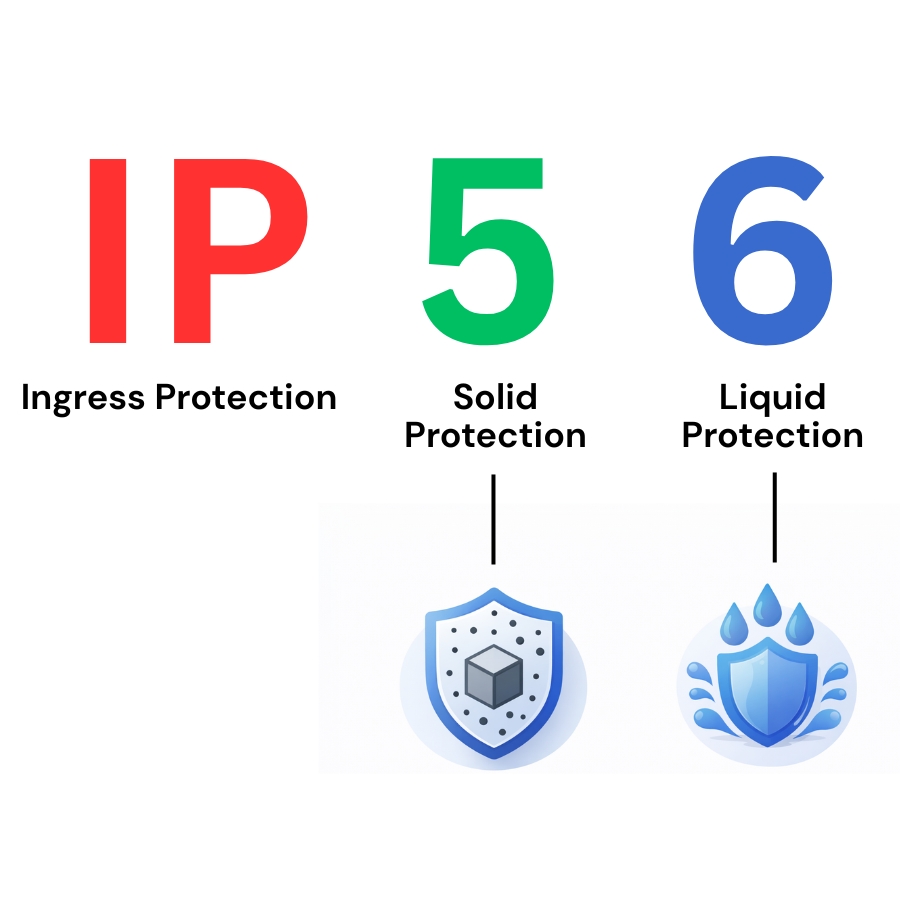
The First Digit: Protection Against Solids (0–6)
The first digit in an IP rating indicates an enclosure's protection against solid foreign objects. This can be anything from fingers and tools to debris and even dust.
The scale runs from 0 (no protection whatsoever) to 6 (completely dust-tight). Yet, in bathroom applications, you'll rarely encounter anything below a 2.
The Second Digit: Protection Against Water (0–9)
The second number, and the most important for bathroom fittings and fixtures, indicates how much water exposure a product can withstand.
This scale runs from 0 (no protection) up to 9 (high-pressure, high-temperature jets from multiple angles), and it's this digit that determines whether a fitting is suitable for use near showers, baths, and basins.
IP Ratings Chart
The tables below break down every level of protection across both digits. It's worth bookmarking and revisiting regularly, especially if you’re planning a full bathroom renovation. Once you're familiar with the scale, specifying products for any room becomes second nature.
First Digit | Level of Protection |
|---|---|
0 | No protection against contact or ingress of solid objects. |
1 | Protection against solid objects greater than 50mm, such as an open palm hand, but not against deliberate contact. |
2 | Protection against solid objects greater than 12.5mm, such as fingers and objects of similar size to fingers. |
3 | Protection against solid objects greater than 2.5mm, such as tools and thick wires. |
4 | Protection against solid objects greater than 1mm, such as fine tools and wires, screws and nails, and large insects. |
5 | Partial protection against dust (dust protection) and similar particles, enough that ingress will not damage and ensure satisfactory operation of the equipment. |
6 | Full protection against dust (dust-tight) and similar particles, where a vacuum must be applied, and tested against continuous airflow. |
Second Digit | Level of Protection |
|---|---|
0 | No protection against water. |
1 | Protection against vertically falling water droplets, such as condensation. |
2 | Protection against vertically falling water droplets when the enclosure is tilted at any angle up to 15°. |
3 | Protection against water sprayed at an angle up to 60°. |
4 | Protection against water splashed against the enclosure from any direction. |
5 | Protection against low-pressure jets of water against the enclosure. |
6 | Protection against powerful jets of water at a rate of 100 litres per minute. |
7 | Protection against the effects of temporary immersion in water. |
8 | Protection against the effects of continuous immersion in water. |
9 | Protection against high-pressure and temperature water jets. |
IPX Ratings
Occasionally, you’ll see an "X" in place of one digit - IPX4, for example. This is simply a placeholder, indicating the product hasn't been tested or rated for that category. This is common in waterproof required bathroom products, where water resistance is naturally the main concern and protection against solid objects is less relevant.
IP Waterproof Ratings: What Counts as Waterproof?
One of the most common misconceptions about IP ratings is that any product with a water-resistance rating must be "waterproof." In reality, there's a big difference between splash-resistant and genuinely submersible, and the distinction matters enormously when you're choosing fittings for wet environments.
An IPX4-rated product, for instance, can handle splashes from any direction. That’s perfectly adequate for a basin area or a bathroom ceiling well away from the shower. An IPX5 product can withstand low-pressure water jets, making it suitable for areas that might catch occasional spray. But neither of these would survive even brief submersion.
True waterproofing, in the sense that most people understand the word, only begins at IPX7, which covers temporary immersion in up to a metre of water for 30 minutes. IPX8 goes further still, covering continuous submersion, though the exact depth and duration depend on the manufacturer's specification.
What really matters is coordinating the rating to the level of water exposure the fitting will actually face in day-to-day use, which brings us to the concept of bathroom zones.
Bathroom Zones and IP Ratings
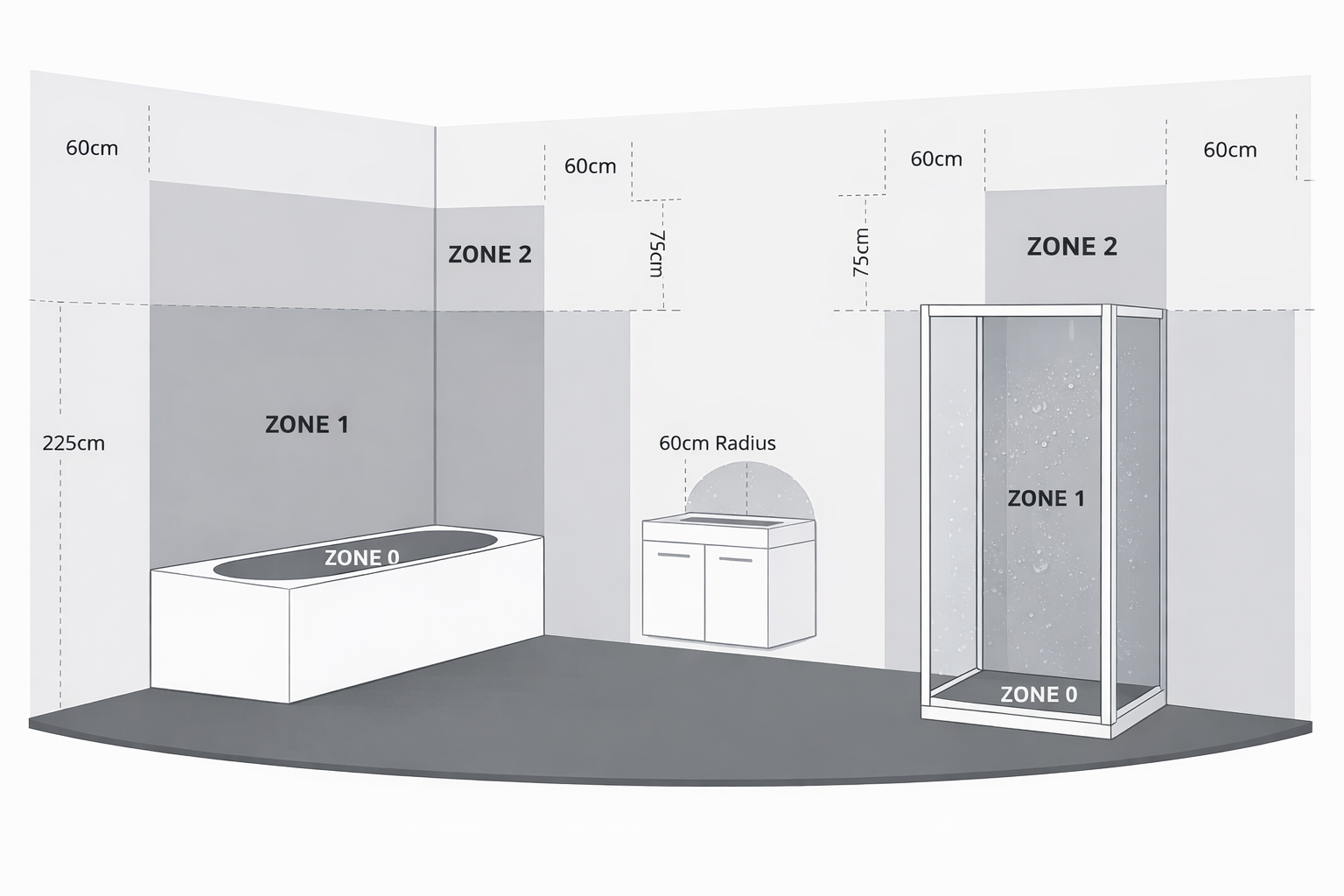
The reason IP ratings matter so much in bathrooms is that UK wiring regulations (BS 7671) divide every bathroom into distinct zones based on proximity to water sources. Each zone carries a minimum IP rating requirement, and fitting a product with an insufficient rating isn't just inadvisable; it's non-compliant and potentially dangerous.
If you're unsure which zone a particular fitting falls within, our bathroom electrical zones guide walks through each one in detail. Complete with diagrams and detailed breakdowns of each zone, it's well worth reading alongside this page before making any decisions.
However, here's a quick summary of the minimum requirements:
- Zone 0: Inside the bath or shower itself. Since any fitting in this area is likely to come into contact with or be submerged in water, fittings used must have a minimum IPX7 rating.
- Zone 1: Directly above or around walls of the bath or shower (up to 2.25m). Since fittings in this area won’t be submerged but will be subject to water splashing, fittings must be at least IPX4.
- Zone 2: Extending 0.6m beyond the bath, shower enclosure or basin. As in zone 1, since splashing can occur, fittings must be at least IPX4.
- Outside Zones: Any area not in contact with collecting water or exposed to water jets. For this, there is no regulatory minimum, though IPX4 is widely recommended as a sensible baseline given the humidity levels in any bathroom.
Which IP Rating Do You Need for Bathroom Lights?
Bathroom lighting is where IP ratings become most practically relevant for homeowners, because the fixtures you choose need to match the zone they'll occupy. Get it wrong, and you risk failing a building regulations inspection - or worse, creating a genuine safety hazard.
Zone 1 Bathroom Lights
For lights installed directly above a shower or bath (within Zone 1), you need a minimum of IP65. The wiring regulations technically require only IPX4 for Zone 1, but most manufacturers and electricians recommend IP65 as the practical standard. The reasoning is straightforward: an IP65 rating means the fitting is completely dust-tight, preventing moisture-laden particles from corroding internal components over time, and providing protection against water jets rather than just splashes.
Recessed LED downlights rated IP65 are the most popular choice for Zone 1. They sit flush with the ceiling, minimise steam traps, and provide clean, even illumination directly where you need it.
Zone 2 Bathroom Lights
In Zone 2, IP44 is the minimum standard for bathroom lighting. This provides protection against small solid objects and water splashes from any direction; more than sufficient for areas such as around vanity units that might catch occasional spray or condensation but aren't subject to direct water flow.
Wall lights flanking a mirror, for example, typically sit within Zone 2 and perform perfectly well at IP44. The same goes for ceiling fittings positioned just beyond the edge of the shower enclosure.
Lights Outside the Zones
Beyond Zone 2, there's no regulatory minimum, but fitting IP44-rated products throughout the bathroom is a sensible baseline of protection. Bathrooms generate significant humidity during use, and even fittings well away from direct water can be exposed to condensation over months and years.
FAQs About IP Ratings
What IP Ratings Do I Need For a Bathroom Extractor Fan?
For an extractor fan positioned within Zone 1 (directly above the shower or bath), IP45 is the minimum recommended rating, though many specifiers prefer IP65 for additional peace of mind. In Zone 2 or beyond, IP44 is sufficient.
Where Do You Put a Shaver Socket in a Bathroom?
Whether installed directly into the wall or as part of a mirrored cabinet, shaver sockets are prohibited in Zones 1 and 0 and must be located beyond either zone. Placed in Zone 2, the socket must have a minimum IP rating of IPX4. In outside zones, there are no specific IP rating requirements, but IPX4 is most used.
Do IP Ratings Apply to Bathroom Furniture and Accessories?
No, IP ratings are specific to electrical and electronic products. Bathroom furniture, taps, brassware and non-electrical accessories aren't assigned IP ratings - their water resistance is determined by the materials and manufacturing processes used. That said, if you're choosing a mirror with integrated lighting or a cabinet with built-in shaver sockets, the electrical components within them will carry their own IP rating.
How Do I Find The IP Rating on a Product?
Most manufacturers display the IP rating on the product packaging and on the fitting itself (often printed or engraved on the base or rear of the enclosure). If you're shopping online, it's usually found under the product's specifications or technical details tab. When in doubt, contact the supplier or manufacturer to confirm.
Putting IP Ratings Into Practice
Once you know how to read them, IP ratings take the guesswork out of choosing bathroom fittings. However, within a bathroom, the most important thing is to check which bathroom zone your fitting will sit in before you buy.
If you have any questions or need help finding the right product for your project, don't hesitate to contact us - we're always happy to help.

