Guide to Towel Rail, Warmer & Radiator Heating Types
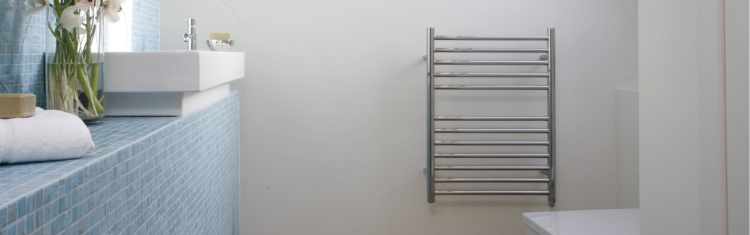
A bathroom radiator has a harder job than any other radiator in the house. It has to warm a room that is often small, poorly insulated, and full of cold, hard surfaces. On top of that, it often has to dry a set of wet towels. How well it manages both comes down to the way it is powered, so it’s worth getting right from the outset.
This guide explains how each type of bathroom radiator heating system works, along with the real advantages and drawbacks of each. It also covers the difference between thermostatic and non-thermostatic models, how to work out the output your bathroom actually needs, and what the jargon on a specification sheet means, from BTUs and watts to Delta T, pipe centres, and projections. The three types are then set side by side so you can see which one fits your home.
- Types of Bathroom Radiator Heating Systems
- Central Heating
- Electric Heating
- Dual Fuel Heating
- Thermostatic and Non-Thermostatic Radiators
- BTUs, Delta T, and Other Jargon
- Which Type is Right for Your Bathroom?
- Get Expert Help Choosing Your Bathroom Radiator
Types of Bathroom Radiator Heating Systems
Two sources of heat classify bathroom radiator types: your home's heating system, which warms water and circulates it through the radiator, or an electric heating element built into the radiator itself. Everything on the market is one, the other, or both.
That gives us three distinct types. A central heating radiator draws its heat from the system, an electric radiator generates its own, and a dual fuel radiator can do either. Which of the three works for you depends less on brand or style and more on what you already have behind the wall: whether there is pipework within reach and whether there is an electrical supply where you need it. The rest comes down to how the room is used, and how much control you want over when it is warm.
Central Heating

A central heating radiator is a water-filled, or wet (hydronic) radiator unit plumbed into your home’s heating circuit, heated by the boiler or heat pump, and typically controlled by the household thermostat and manual radiator valves.
Hydronic means water-based. It describes any system that moves heat around a building in hot water, which is how most UK homes are heated, so hydronic, wet, and central heating all mean the same thing here.
A central heating radiator works on a pair of pipes. The flow pipe brings hot water from the boiler in through an inlet valve, and the return pipe carries the cooled water back to be reheated. As hot water passes through the radiator core, it transfers heat to the metal.
It’s worth stating that a central heating radiator covers far more than gas. The same wet system can be fed by an oil boiler, an electric boiler, an air source or ground source heat pump, or solar thermal panels. A central heating radiator works the same way, regardless of which one is heating the water.
How hot the water reaches the radiator is determined by the heating system, rather than the radiator itself. This is known as the flow temperature, and it is one reason the same radiator can deliver different heat outputs in different homes. Generally, hotter water makes the radiator hotter and increases the heat it can give off; cooler water reduces its output. A traditional boiler operating at a higher flow temperature - often around 65–75°C - will make a radiator feel hot to the touch and deliver more heat. Heat pumps usually operate at lower flow temperatures, commonly around 45–55°C for radiator systems.
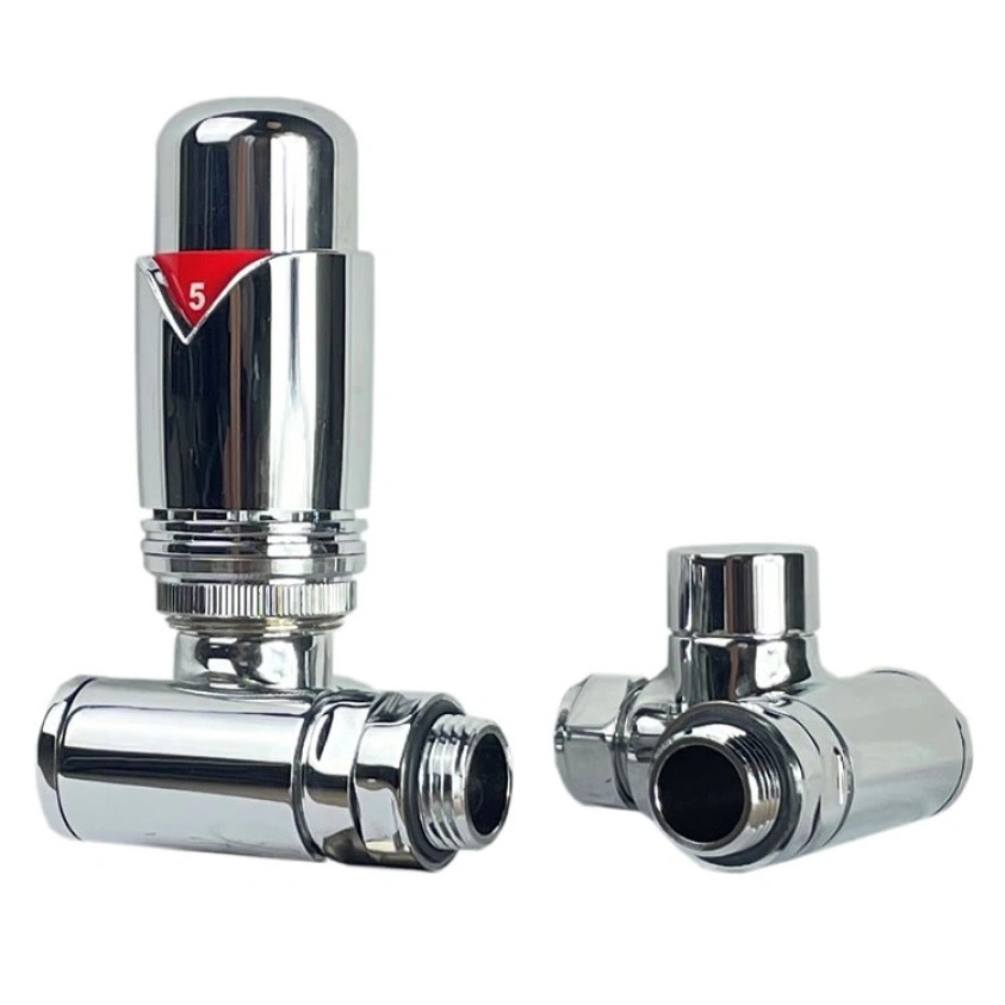
What the boiler does not decide is how warm the room gets. That is controlled at the radiator itself, by the valves on either end. The further open the valve, the more hot water can enter, thus giving the radiator more heat to output. If you're interested in seeing exactly how these small devices work, our guide to radiator valves covers every type in detail.
Pros and Cons of a Central Heating Bathroom Radiator
Pros:
- High Heat Output on a Conventional System: When run at a typical boiler flow temperature, a central heating radiator will usually produce more heat than an equivalent electric one, making it the stronger choice for a larger or poorly insulated bathroom.
- Cheaper to Run Per Unit of Heat:Gas costs substantially less per kWh than electricity, so heating the bathroom through the central heating circuit is cheaper than heating it electrically whenever the system is running. How much cheaper depends on what heats your water: the gap narrows with oil, and with a heat pump the comparison changes entirely because a heat pump returns several units of heat for every unit of electricity it draws.
- Reliable Ambient Warmth (and Less Mould): It provides a consistent level of background warmth rather than only radiant heat, which keeps surfaces closer to air temperature. In turn, this means less condensation forms and less chance of surfaces staying wet, reducing the chance of bathroom mould and mildew establishing themselves.
- Electrical Safety: Relying solely on central heating, nothing is electrical. This means a central heating radiator is not affected by the bathroom electrical zones set out in BS 7671, and IP ratings on the radiator itself do not apply.
Cons:
- Tied to the Heating Schedule: Because it runs with the main central heating, you cannot warm the bathroom or dry towels in the warmer months without firing up the whole system to heat one room. Most UK households switch the heating off throughout summer, leaving the radiator cold for a quarter of the year or more.
- Installation Complexity: Adding or moving a central heating radiator usually requires a plumber to alter pipework, rebalance the system, and work to the relevant regulations, which adds both cost and disruption.
- Position Dictated by Pipework: Where the radiator can go is largely decided by where the flow and return can practically reach.

Radox Maze Stainless Steel Heated Radiator
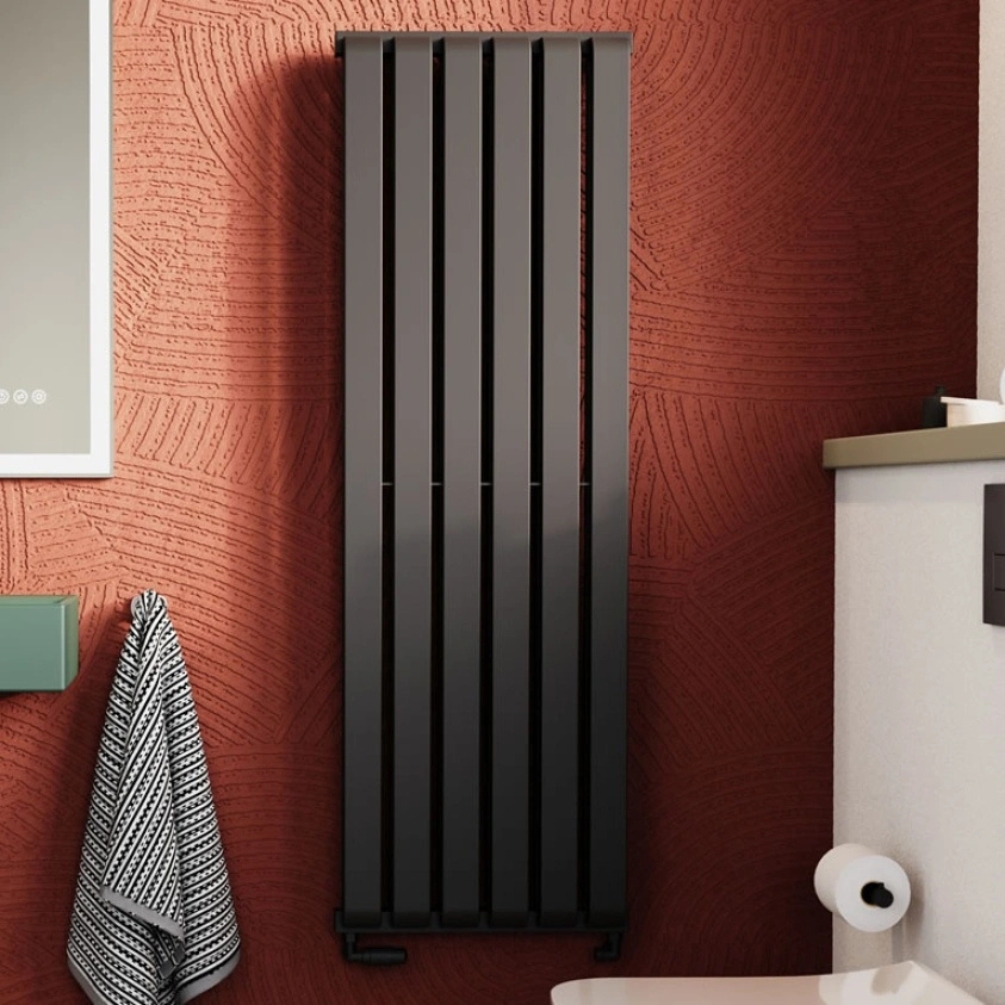
Crosswater Limit Metallic Black Heated Radiator
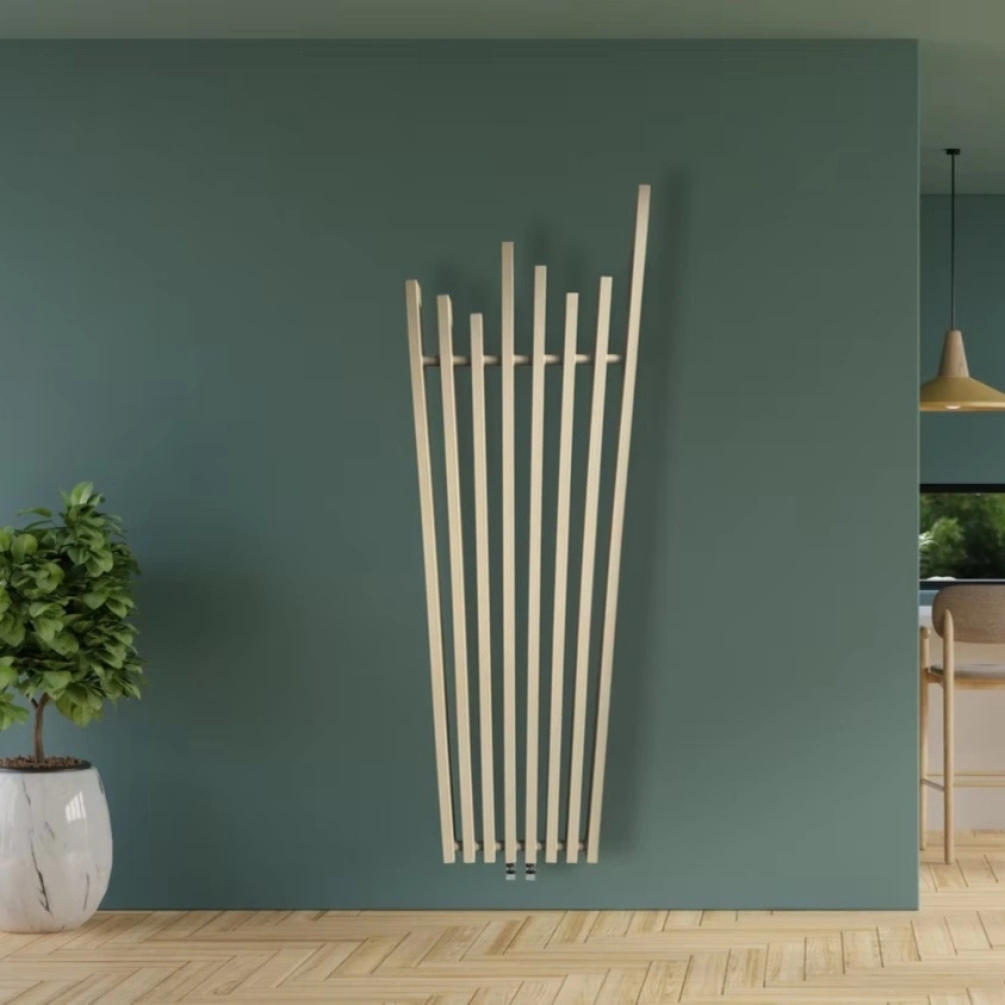
Radox Manhattan Cappuccino Heated Radiator
Electric Heating

An electric radiator works as a sealed unit with no connection to your central heating. It runs on an electrically powered heating element that heats and circulates a pre-filled thermal fluid, usually oil or glycol, around the radiator body.
Because it functions independently, it has its own controls: a thermostat, usually a timer, and on many models, a boost function or app control. It heats when you tell it to, regardless of what the boiler is doing. In place of pipework, it needs a fused electrical supply, taken from an appropriate circuit and switched from outside the bathroom zones.
Pros and Cons of an Electric Heating Bathroom Radiator
Pros:
- Complete Independence: You can heat the bathroom or dry towels without turning on the whole heating system, which makes an electric radiator the ideal choice through spring and summer.
- Improved Control: Because the controls belong to the radiator rather than the house, you can schedule, boost, and set temperatures for that one room, in many cases through an app or voice control. Nothing plumbed offers this level of precision.
- Flexible Installation: With no flow and return to reach, the radiator can go where it makes sense rather than where the pipework allows, and installation is usually simpler and less expensive than plumbing one in.
Cons:
- Higher Hourly Running Costs: In the UK, electricity typically costs substantially more per kWh than mains gas. Under Ofgem’s July–September 2026 price-cap rates, the average electricity unit rate is 26.11p/kWh, compared with 7.33p/kWh for gas. As a result, a direct electric radiator will usually cost more to provide the same amount of heat than a gas-fired central-heating system, although actual costs vary by tariff, boiler efficiency, and home.
- Requires Qualified Installation: This is not a DIY job. An electric radiator is a fixed appliance in a wet room, so it has to be installed in accordance with BS 7671, carry an IP rating suited to the zone it sits in, and be isolated or switched from outside those zones.
- Fixed, and Usually Lower Output: An electrical element's wattage sets a maximum on how much heat the radiator can produce, and for a given model that ceiling is typically lower than the same radiator would reach plumbed into a conventional boiler system. The trade-off is predictability: an electric radiator produces the same output every day regardless of what the heating system is doing, but in a large or high-ceilinged bathroom it can leave the radiator struggling as the only source of heat.
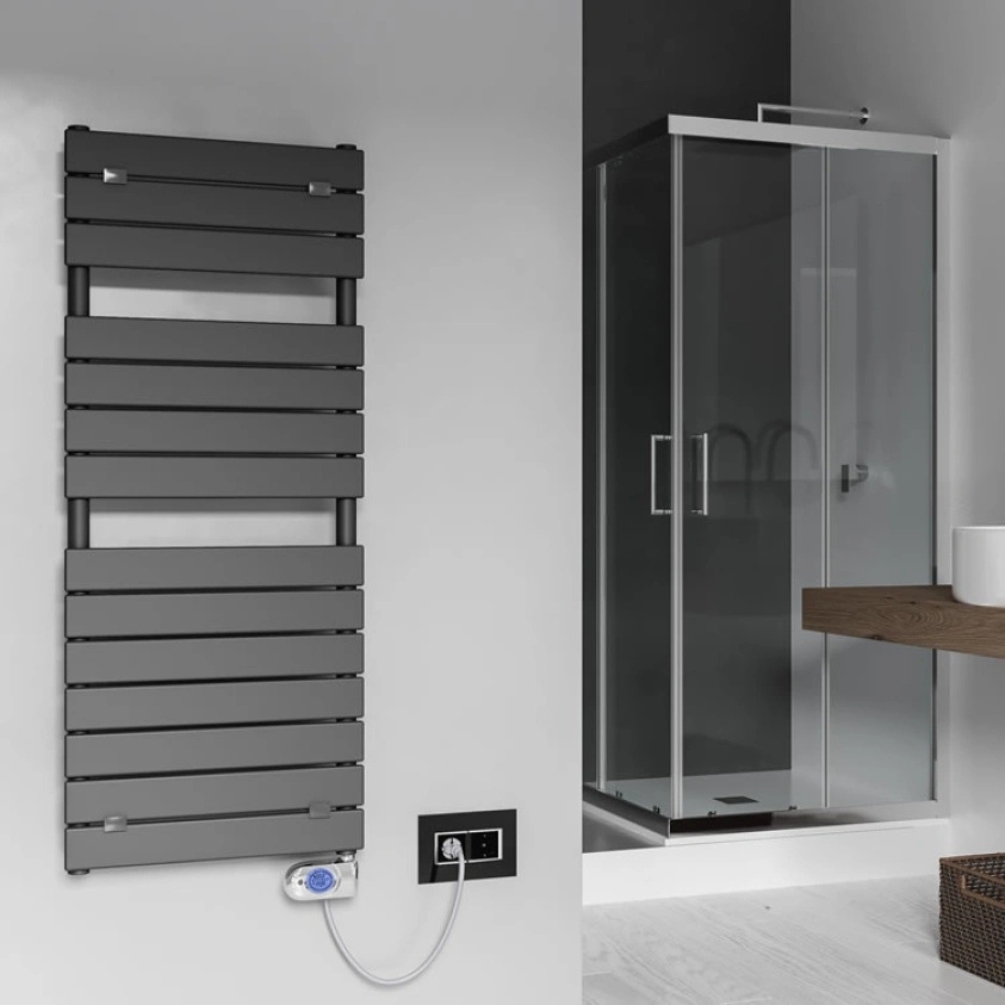
Lazzarini E-Palermo Anthracite Electric Towel Radiator
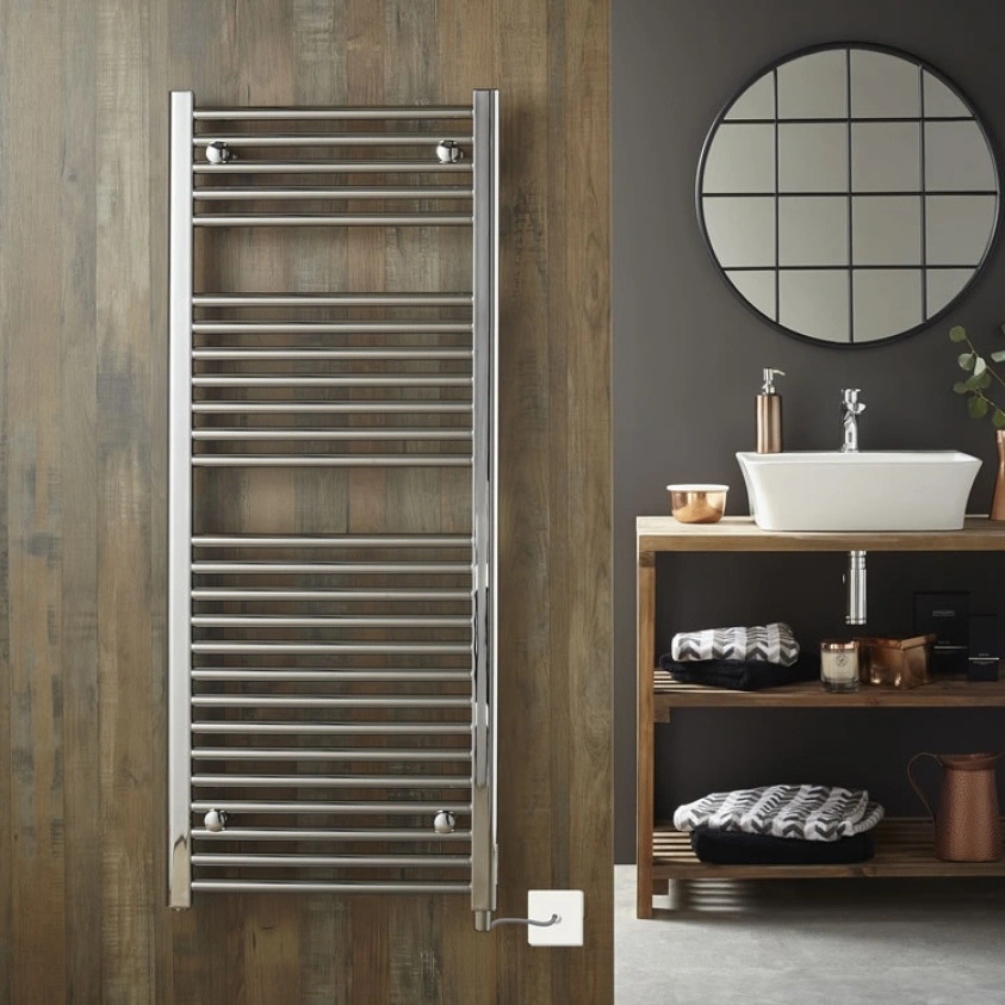
Velaro Eland Straight Electric Towel Rail
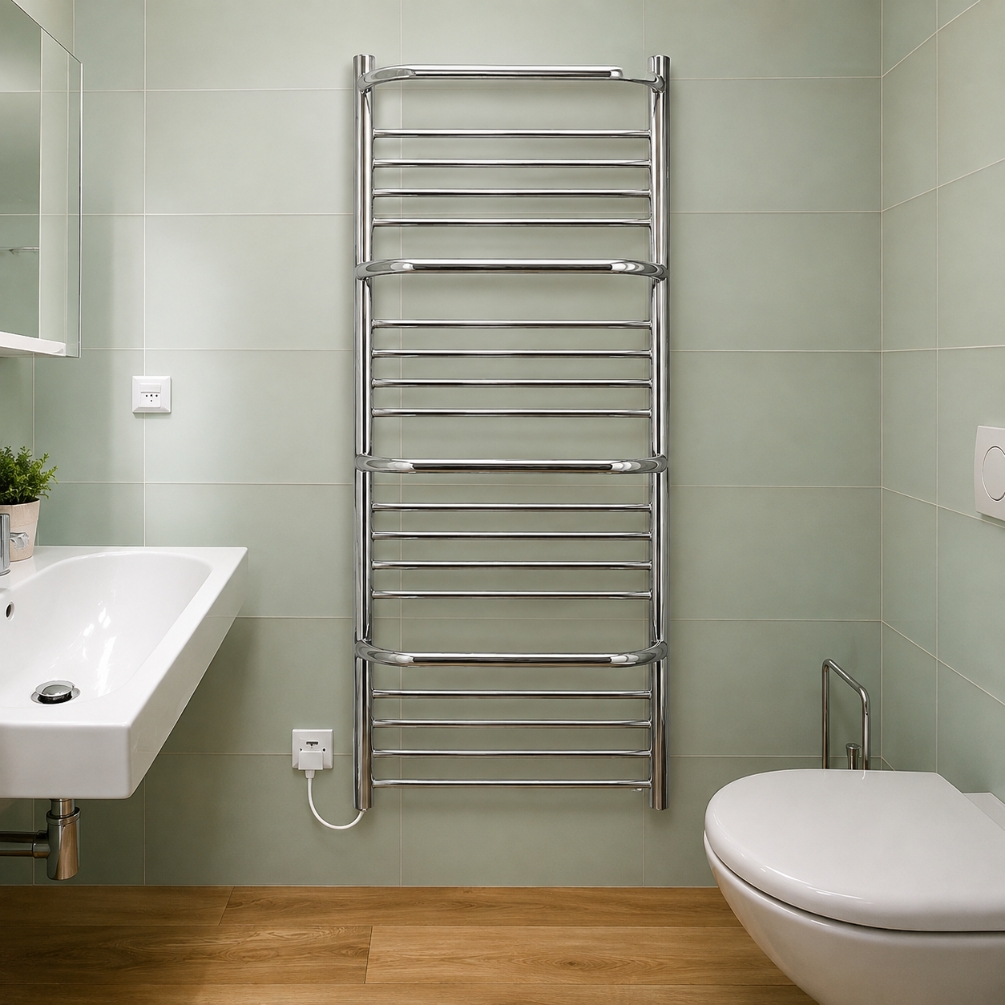
The Sussex Range by JIS Findon Stainless Steel Electric Towel Rail
Dual Fuel Heating
A dual fuel radiator combines a central heating radiator and an electric radiator into a single unit. It is plumbed into the central heating circuit in the ordinary way but also has an electric element fitted so that it can be heated either way.
A dual fuel radiator works by switching between its two heat sources, and the setup is usually constructed using a T-piece or dual fuel valve, which accommodates both the central-heating connection and the element. In central-heating mode, the element is off, and the radiator operates like any other wet radiator: its valves are open, hot system water flows through it, and the boiler heats it along with the rest of the house. In electric mode, the flow and return valves are closed, which isolates the radiator from the circuit. The element then heats only the water contained in the radiator, so it behaves exactly like an electric one. Open the valves again, and it rejoins the circuit, filled with system water and heated by the boiler along with every other radiator in the house.
Pros and Cons of a Dual Fuel Bathroom Radiator
Pros:
- Cost-Effective, Year-Round Use: This is the radiator that is never out of season. The central heating side carries the colder months at the lower cost per unit, and the element takes over through the warmer months. This means there is no month in which it cannot dry a towel or heat a room on a chilly night, and no need to fire up the boiler for the whole house to deal with it.
- Built-In Backup: If the boiler fails, the radiator can still be run on its electric element, so the bathroom keeps a source of heat while you wait for a repair.
Cons:
- More to Go Wrong: There are more components than either alternative: valves, an element, and its supply on top of the plumbing. Nothing about it is fragile, but more can eventually need attention.
- Correct Valve Setup Required: The radiator depends on the right valve arrangement to isolate it from the circuit, and switching between modes is not always fully automatic, so it is worth asking your installer exactly how yours changes over.
- Highest Upfront Cost: Every type carries extras, so the gap here is narrower than it first looks. A central heating radiator still needs a pair of valves, and an electric one still needs an element and, depending on the valves used, a T-piece. Dual fuel needs both, and more crucially, it needs two trades on one appliance: a plumber for the pipework and a qualified electrician for the element.
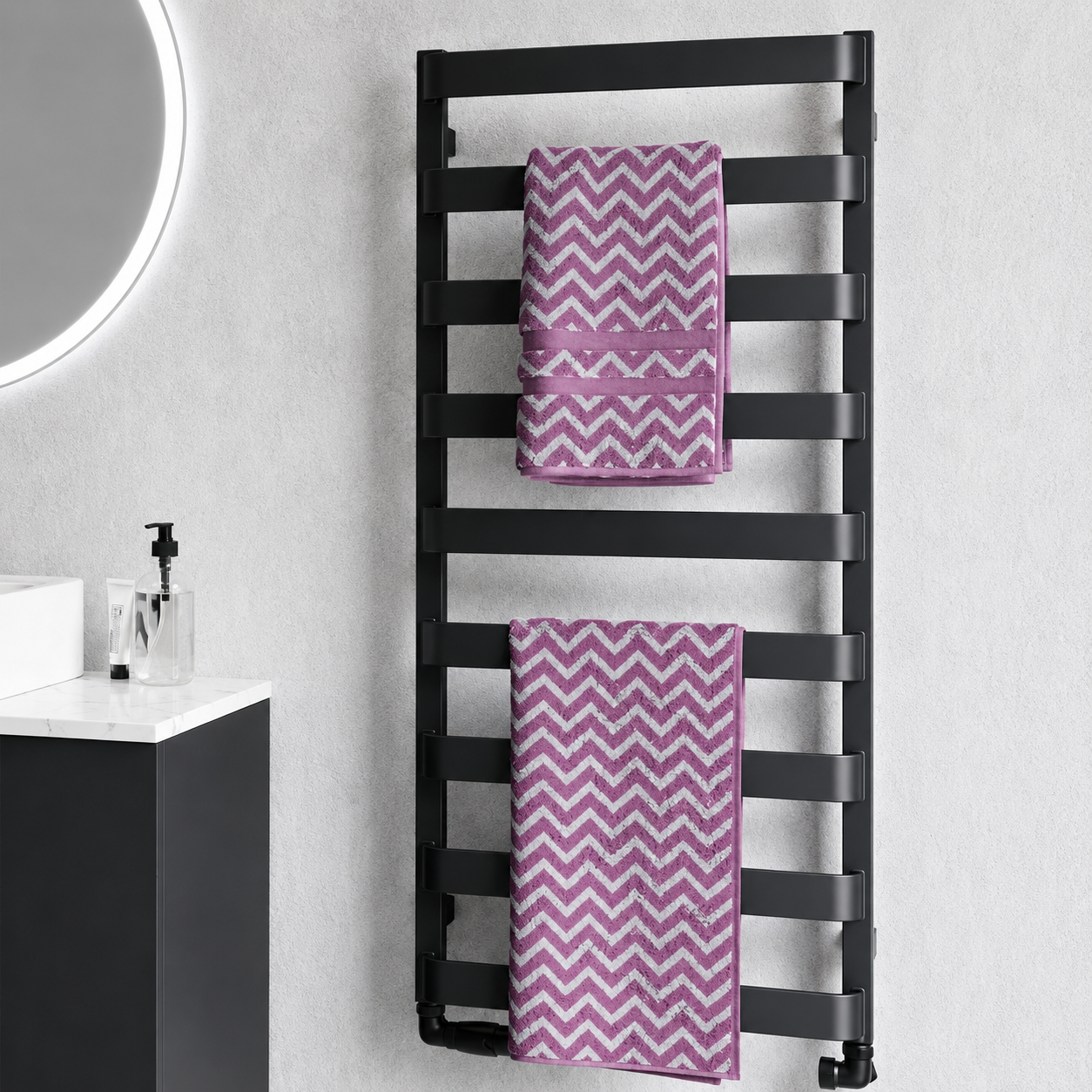
Crosswater Air Metallic Black Towel Warmer

The Sussex Range by JIS Rye Black Heated Leaning Towel Rail
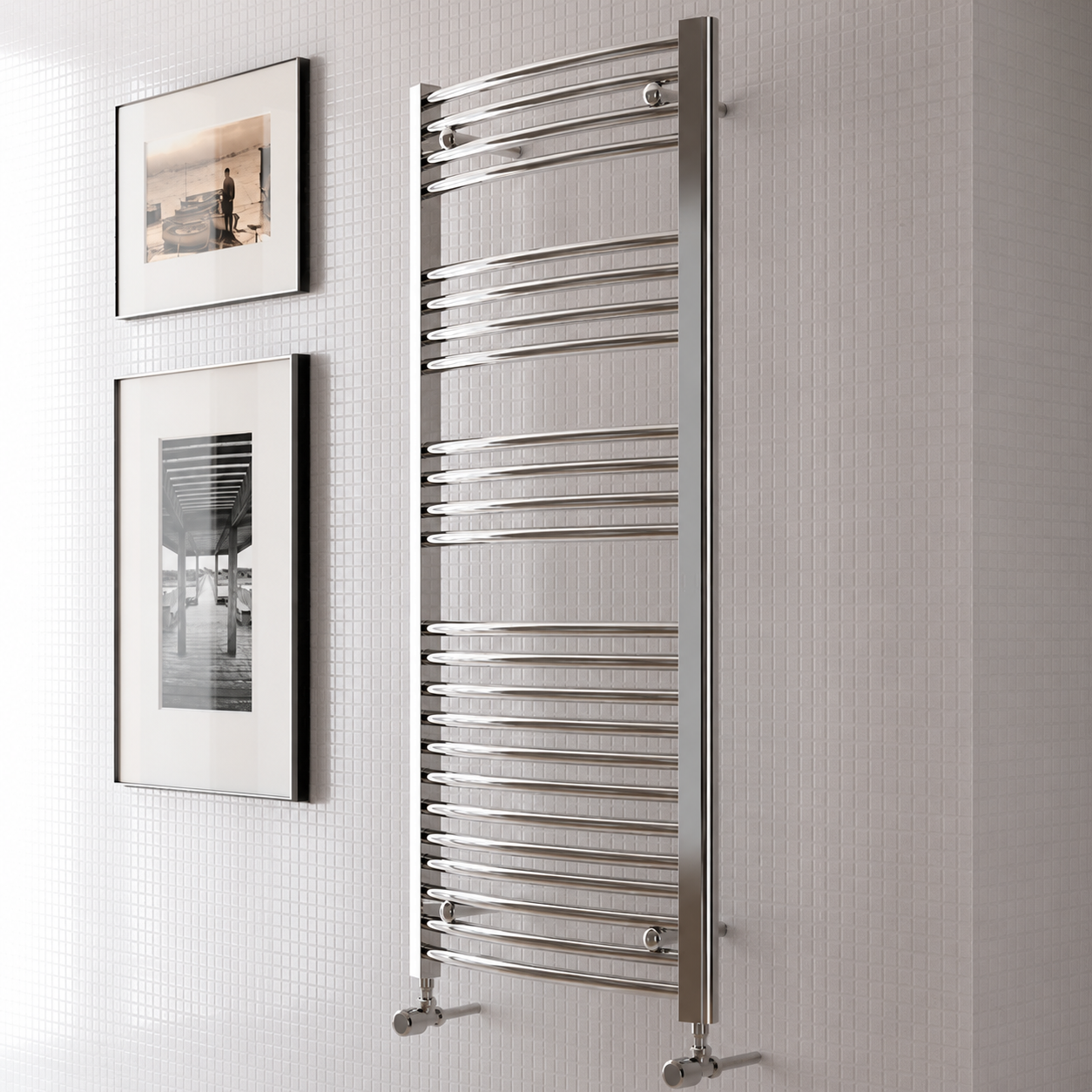
Radox Premier Curved Chrome Towel Radiator
Thermostatic and Non-Thermostatic Radiators
One further distinction that cuts across all types is the feature of thermostatic control; whether the radiator can hold a temperature you have set or simply runs at whatever temperature it happens to reach. It makes very little difference to how a radiator looks but a fair amount on how economical it is to run, so it is worth checking before you order.
Thermostatic
A thermostatic radiator lets you set a target temperature and then maintains it rather than heating continuously. They function by constantly adjusting themselves, ensuring they never use more energy than they need - saving up to around 40% in some households - and fine-tuning room temperature to be comfortably warm.
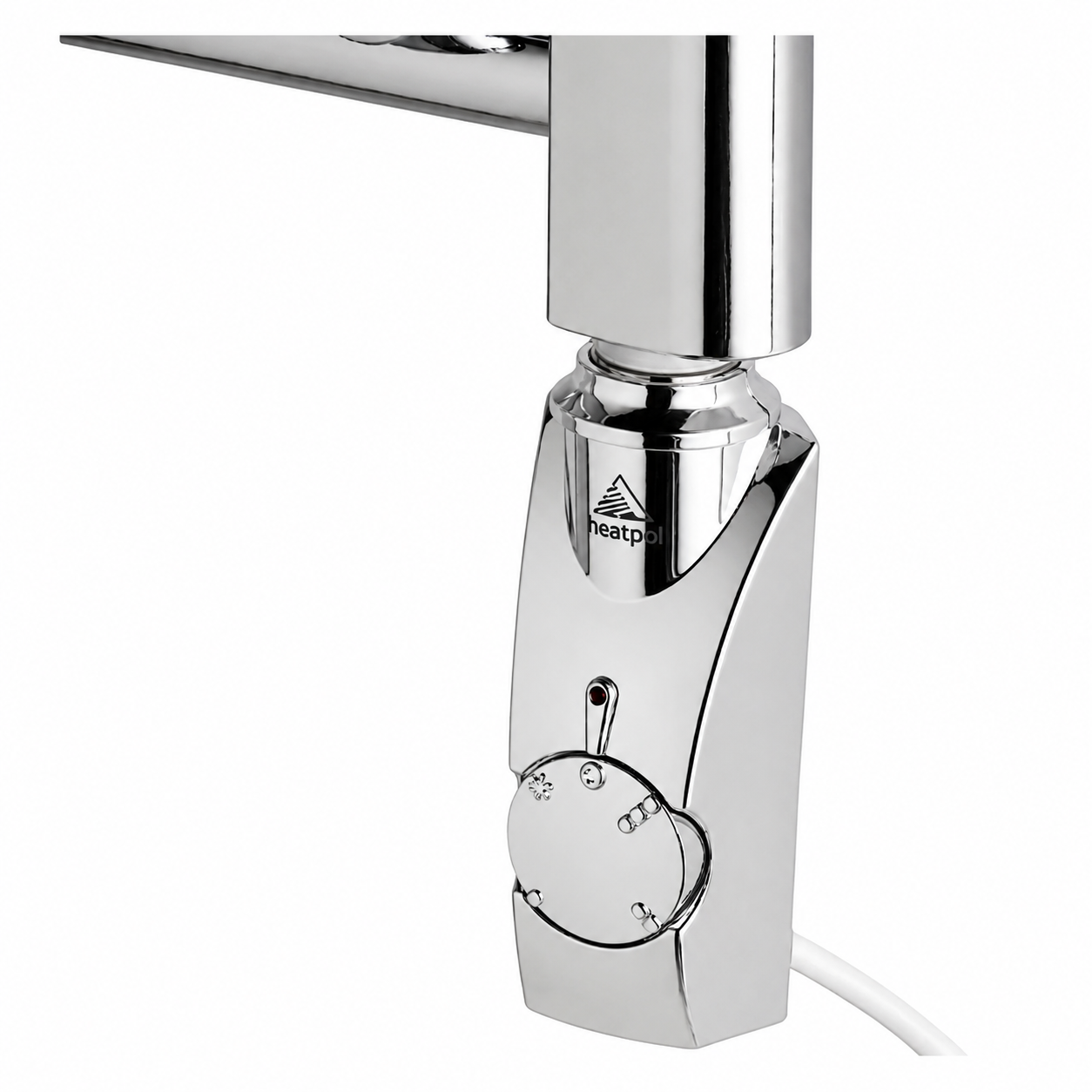
On an electric radiator, that means a thermostatic element heats the fluid inside until it reaches the set temperature, then cycles off and draws power again only to bring the temperature back up. That cycling is where the savings come from, because the element is not running flat out for the entire time the radiator is switched on.
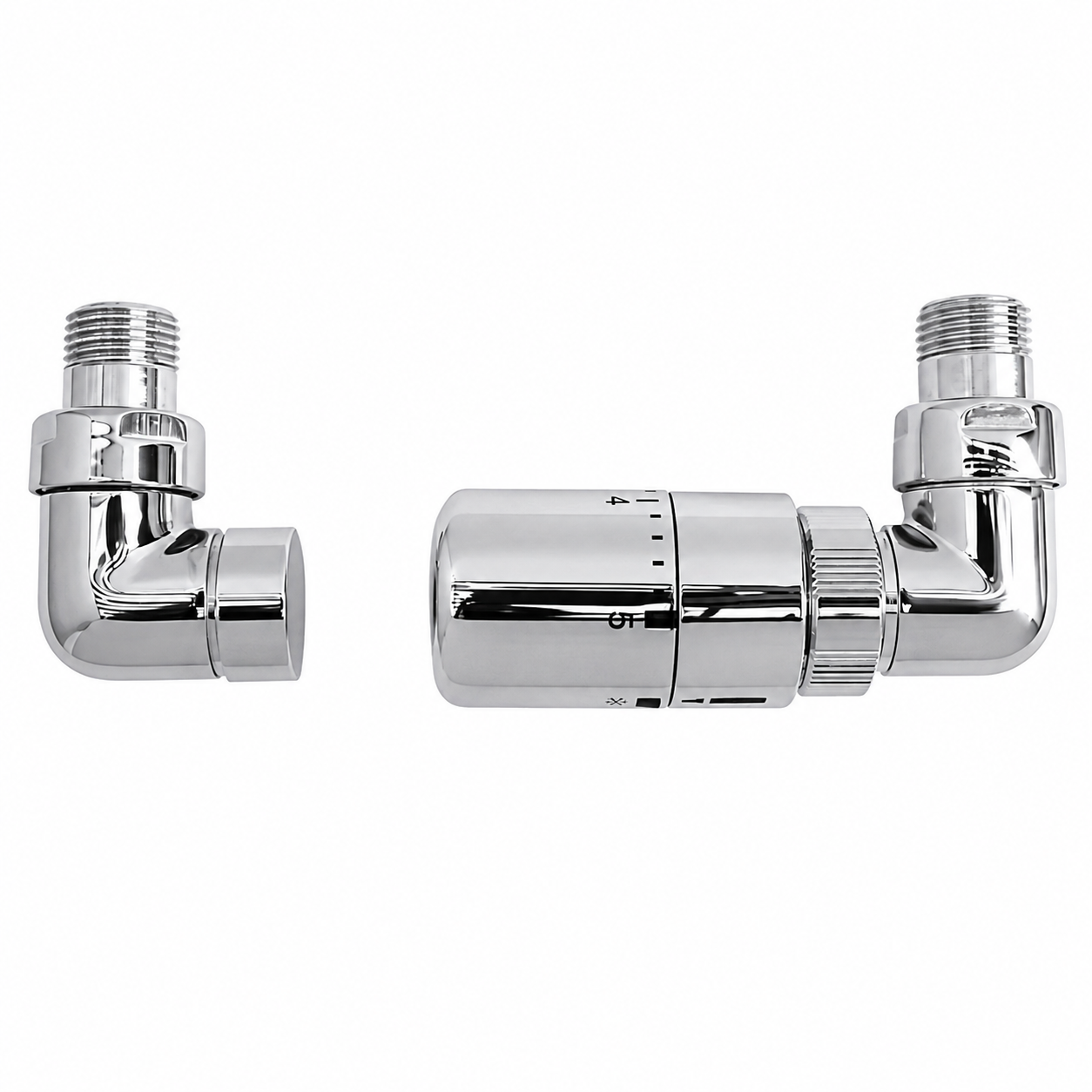
For a central heating and dual fuel radiator, the equivalent is a thermostatic radiator valve (TRV), performing the same job as a thermostatic element but restricting the hot water entering rather than switching the power off.
Non-Thermostatic
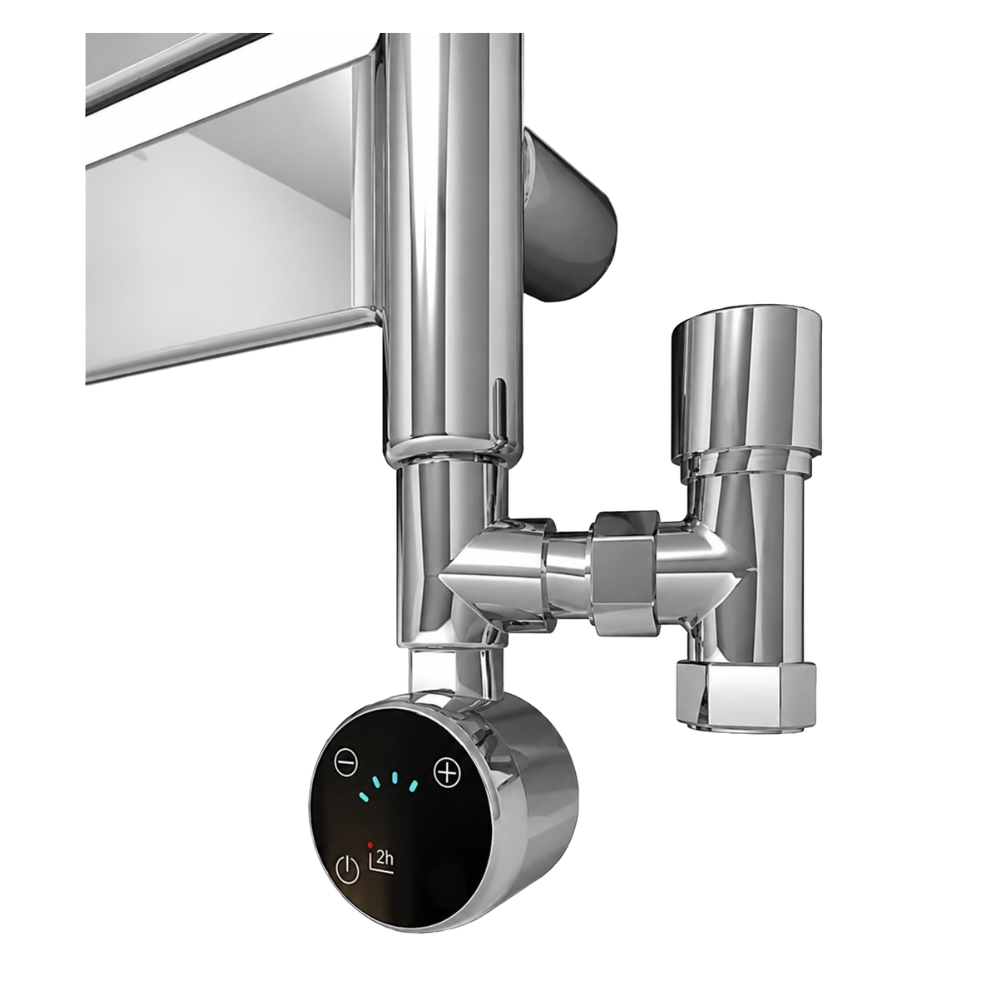
Conversely, a non-thermostatic radiator has no built-in temperature settings. Once it is on, it runs at a fixed output and reaches whatever temperature the fixture's element can reach. This means the only control you have is on and off, whether that comes from a manual switch, plug-in timer, or the household programmer.
BTUs, Delta T, and Other Jargon
Choosing the type is half the job. The other half is choosing one that performs correctly for your room, and that is where product specifications start speaking a language of their own. Here are the common terms you'll come across, what they mean, and how to use them.
BTUs and Watts
Some manufacturers quote watts, others BTUs, so it is worth being able to move between the two. Watts and BTUs per hour are simply different units for the same thing: how much heat is being produced.
BTU stands for British Thermal Unit. Widely used in the UK, it represents the amount of energy required to raise the temperature of one pound of water by one degree Fahrenheit. A watt, by contrast, is a unit of power, defined as an energy transfer of one joule per second, and it forms part of the International System of Units.
Because watts are a global standard, they turn up everywhere. In practice, though, they are most closely associated with electrical products, for the obvious reason that anything drawing electricity is already rated that way. For bathroom radiators, that means wattage appears most often on electric models, particularly ranges sold into several countries where watts rather than BTUs are the expected measurement.
To convert between the two is simple: one watt is roughly 3.412 BTUs per hour. Multiply watts by 3.412 to get BTUs, or divide BTUs by 3.412 to get watts. A 500W radiator is therefore around 1,706 BTUs, and a 2,000 BTU radiator is around 586W.
Wattage has one practical advantage when you are choosing an electric radiator: it makes running costs easy to work out. Your energy supplier prices electricity in pence per kWh, so divide the wattage by 1,000 to get kilowatts, multiply by the hours you expect it to run, and multiply that by your unit rate. A 500W radiator running for two hours uses one kWh, so it costs you a single unit of electricity.
Working Out the BTU You Need
How much heat a radiator needs to give out depends on how much heat the room loses. A BTU calculator works that out for you. It will ask for the length, width, and height of the room, along with the insulation, the glazing, and what the room is used for.
Measure carefully first. Take all three dimensions from the finished floor level and the finished wall surfaces, not the bare structure. A small error in each one adds up quickly, and an undersized radiator is a mistake you notice every morning.
One thing to know before you buy: a towel rail may not reach that figure on its own. A conventional ladder towel rail will generally give out less heat than a panel radiator of similar dimensions, because its open-bar design provides less effective heated surface area. Hanging towels over it reduces that again, because covered bars and blocked airflow cut how much heat reaches the room.
None of that matters if another radiator or underfloor heating is doing the main work. If the rail is the only heat source, it has to cover the room's full requirement on its own. That usually means a flat panel towel radiator with a higher output, or a compact rail paired with a separate radiator sized for the room. Either way, treat the output figure on the product page with some care, because it is measured under test conditions rather than the ones in your house. Delta T is what tells you the difference.
Delta T
A radiator does not have one fixed BTU/h or watt output. It gives out more heat when it is much hotter than the room, and less when that gap narrows. Delta T, also written as ΔT, is the name for the gap. It's calculated by subtracting the room temperature from the average water temperature inside the radiator; the difference is the Delta T. For example, a radiator holding water at an average of 70°C in a 20°C room is running at ΔT50.
That is why manufacturers quote output at a stated Delta T rather than as a single number. Most quote ΔT50, the standard test condition under BS EN 442, but some use ΔT60 for a headline figure.
To work out what a radiator gives at a different Delta T, multiply its published ΔT50 output by the correction factor below. For example, at ΔT30, the correction factor is 0.51. This means the radiator produces around 51% of its quoted ΔT50 output: 2,000 BTU/h X 0.51 = 1,020 BTU/h. So, a towel rail rated at 2,000 BTU/h at ΔT50 would provide around 1,020 BTU/h at ΔT30. Where the manufacturer publishes its own correction table, use that instead, as the figures vary slightly between radiator types.
Delta T | Correction Factor |
|---|---|
ΔT70 | 1.55 |
ΔT65 | 1.41 |
ΔT60 | 1.27 |
ΔT55 | 1.13 |
ΔT50 | 1.00 |
ΔT45 | 0.87 |
ΔT40 | 0.75 |
ΔT35 | 0.63 |
ΔT30 | 0.51 |
ΔT25 | 0.41 |
Pipe Centres
Pipe centres are the distance between the centres of the two valve connections, and they decide whether a radiator will line up with pipework that is already in place. If the centres do not match what is on the wall, the pipework must be moved, or angled or offset valves used to bridge the difference, which is worth knowing before the radiator arrives rather than after.
Projections
Projection is how far the radiator stands out from the finished wall once it is fitted, including brackets. This is worth checking in a narrow bathroom or next to a door swing.
Central Heating, Electric, and Dual Fuel at a Glance
Side by side, the three options are fairly distinct. Most of the decision comes down to the following seven things:
Which One Fits Your Situation?
Central heating usually makes the most sense when:
- The rest of the house is being heated anyway.
- The radiator is mainly wanted through the colder months.
- The bathroom can run on the same schedule as everywhere else.
- There is pipework already close to where the radiator needs to go.
Electric usually makes the most sense when:
- Only the bathroom needs warmth, rather than the whole house.
- The heating is switched off for much of the year.
- You want short, timed bursts instead of background warmth.
- Towels still need drying through the summer.
- There is no wet heating system to connect to, or none within reach.
Dual fuel usually makes the most sense when:
- You want the radiator available in any month of the year.
- The heating runs regularly through the winter.
- Towels need drying when the boiler is off.
- The radiator is heating the room as well as drying towels.
Get Expert Help Choosing Your Bathroom Radiator
Bathroom heating is not a complicated decision once the options are laid out side by side. It comes down to how your home is already heated, how the room is used across the year, and what the budget allows. There is no single right choice for every bathroom, and what works well in a family bathroom is often the wrong answer for an ensuite down the hall. The point worth holding on to is that this is a decision to settle early, while the pipework and the electrics are still accessible, rather than something to work around once the room is finished.
If you would like help matching a type to your own bathroom and heating system, get in touch with our expert team, and we will talk it through with you. Whichever type your bathroom calls for, we stock it. Our range of bathroom radiators and heated towel rails covers central heating, electric, and dual fuel models from JTP, Crosswater, Eastbrook, Radox, and JIS, across a spread of sizes, outputs, and finishes.

